

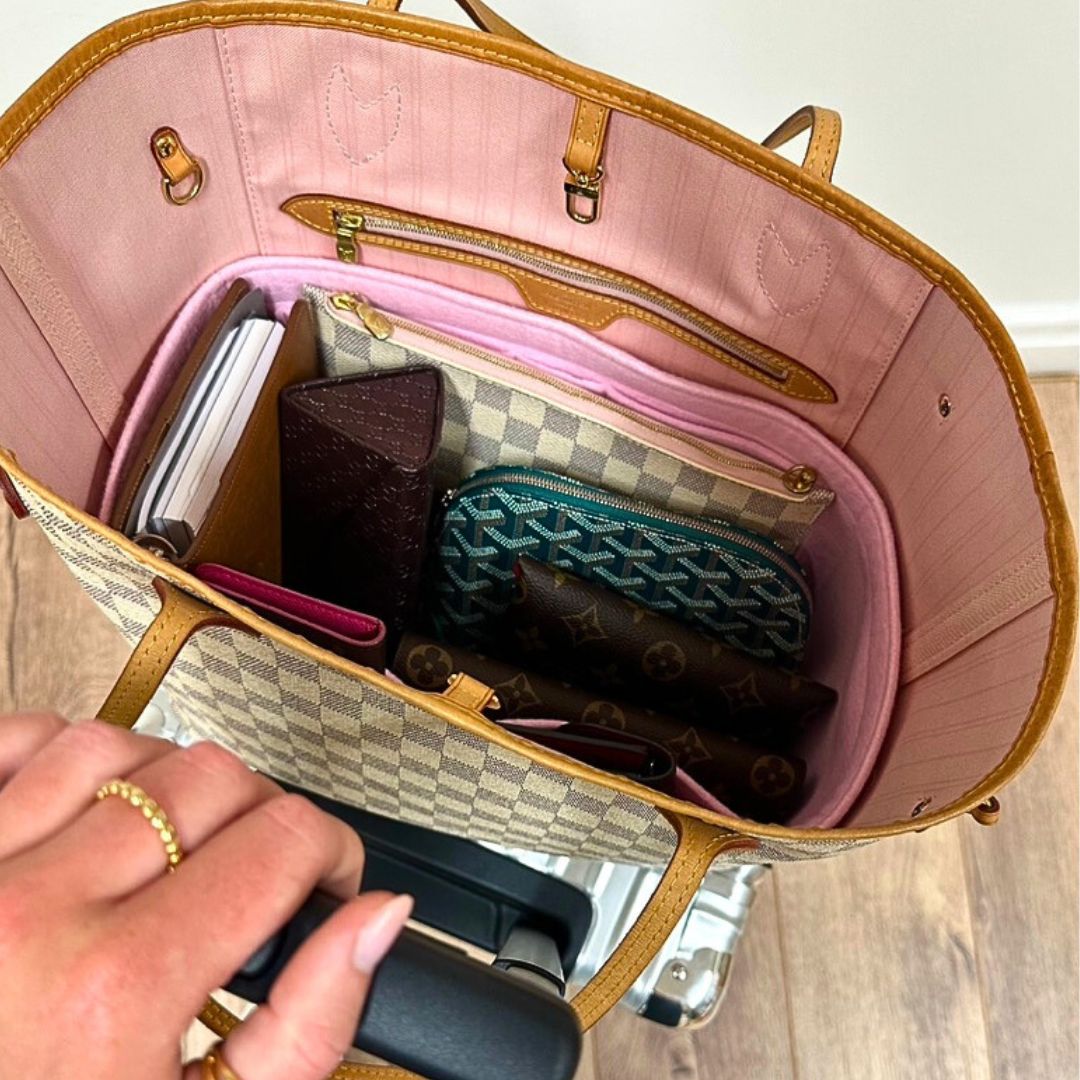
Tips on How to Organise Your Handbag
An organised handbag just makes everyday life simpler. It saves time, protects your investment and preserves the shape of your bag. Whether you carry a structured tote, a crossbody or a spacious travel bag, keeping the interior organised ensures you can find essentials quickly while protecting delicate linings from unnecessary wear.
In this guide, we explain how to create and maintain an organised handbag, how to choose the right handbag insert or handbag liner, and how to protect luxury interiors without compromising design or storage space.
Why an Organised Handbag Matters
Luxury handbags are crafted with balance, proportion and structure in mind. Without effective internal organisation, even a well-designed bag can lose shape or become cluttered.
An organised handbag helps to:
-
Prevent scratches from keys and other sharp items
-
Reduce the chance of staining from items like cosmetics and pens
-
Maintain the bag’s silhouette
-
Save time when switching between bags
-
Keep daily essentials easy to locate
Loose items shift throughout the day. Over time, that movement can weaken the base of your bag. In addition, pens can leak or cosmetics may open and stain the interior, and sharp objects may leave marks on delicate fabrics.
Using a liner or insert reduces internal friction and helps stabilise the contents of the bag. Instead of everything moving around freely, items remain separated and organised, and the structure of your bag is supported, rather than altered by the movement of contents.
That being the case, it should be clear that organisation is not about adding bulk. It is about preserving craftsmanship, and doing so while also making the bag more practical to use.
How to Declutter Before Creating an Organised Handbag
Before adding a handbag liner or insert, decluttering is essential. Organising layered over unnecessary items only hides the issue rather than solving it.
Step 1: Empty the Bag Completely
Place all contents on a flat surface. Seeing everything at once provides a clearer understanding of what you actually carry each day.

Common items that accumulate include:
-
Old receipts
-
Expired loyalty cards
-
Loose coins
-
Empty packaging
-
Unused cosmetics
Removing these immediately creates more usable space and reduces unnecessary weight.
Step 2: Separate by Frequency of Use
Divide everything into three categories:
-
Daily essentials
-
Occasional items
-
Remove or relocate
If something is rarely used, it does not need permanent space inside your bag. Items used occasionally can be stored separately and only added when necessary.
Step 3: Define Core Essentials
A practical handbag usually contains a number of commonly-seen items that most people carry with them, such as:
-
Wallet or card holder
-
Keys
-
Phone
-
Small cosmetic pouch
-
Sunglasses
-
Personal necessities - anything that you simply can’t imagine not having with you at any point in the day
De-cluttering and downsizing what stays inside like this makes any organised handbag easier to maintain, and prevents overcrowding.

Choosing the Right Handbag Insert for You
A well-fitted insert provides structure and separation. However, not all inserts are suitable for all luxury bags.
A poor fit can distort shape, create tension on seams, or interfere with closures. Precision is key.
|
Feature |
Benefit |
|
Tailored fit |
Prevents sagging and wasted space |
|
Structured base |
Supports the bottom panel |
|
Multiple compartments |
Keeps items upright and separated |
|
Lightweight material |
Adds structure without excess weight |
|
Soft finish |
Protects delicate interiors |
When selecting an insert, it is also helpful to consider how you typically use your bag. For example, if you regularly carry chargers, headphones or other small electronics, additional compartments can prevent cables from becoming tangled with other belongings.
However, don’t forget that when selecting a liner for a bag such as a Chanel Classic Flap or Louis Vuitton Neverfull, the insert must align with the internal dimensions to preserve the original silhouette. A properly sized insert should sit comfortably inside the bag without pushing against the sides or altering the external shape.
When to Choose a Handbag Liner Instead
A liner focuses primarily on protection rather than structured separation. So, if your main priority is shielding the interior from marks left by ink, cosmetics, or other sources of staining, a liner may be sufficient. This is particularly useful for bags with light-coloured interiors that show marks more easily.
Some liners include light compartmentalisation too, offering moderate organisation while maintaining a slim profile. These options provide a balance between protection and flexibility.
For those who prefer minimal added structure, a liner offers subtle protection without changing the internal feel of the bag, and they can also be a good option for softer handbags where a rigid insert may not feel appropriate.
Combining a Handbag Insert and Handbag Liner
Many luxury bag owners choose a ‘structured liner’, an option that combines the organisational advantages of an insert, and the protective benefits of a liner.
This hybrid solution:
-
Supports the base
-
Separates essentials
-
Protects the original lining
-
Reduces wear from friction
Because structured liners combine structure and protection, this approach helps maintain both the appearance and functionality of an organised handbag.
Handbag Angels specialises in handmade organisers created as liners for specific designer brands and bag models. These carefully tailored accessory liners are designed to fit particular styles while respecting the original craftsmanship of the bag.
Common Mistakes That Can Ruin an Organised Handbag
Even with an insert or liner, certain habits can gradually disrupt organisation within your bag. On the other hand, avoiding the following common mistakes helps maintain a consistently organised handbag:
Overloading the bag
Carrying unnecessary items adds weight that can strain the base and handles. Excess weight also reduces the effectiveness of internal organisers.
Using inserts that are too large
An oversized insert can push against the sides of the bag and distort its silhouette. Choosing a correctly fitted organiser is essential.
Ignoring small spills
Cosmetics and pens can leak without warning. Cleaning marks quickly prevents stains from settling into the lining.
Letting clutter build up
Receipts and loose items tend to accumulate gradually. However, the ‘ritual’ of a quick weekly reset prevents clutter from returning.
Maintaining an Organised Handbag Long-Term
We mentioned the ‘ritual’ above because organisation works best when it becomes a part of your routine rather than an occasional task. However, even the best handbag insert cannot prevent clutter if positive habits are neglected, so our advice is to try the following good practices out and see where you can weave them into your day or week.
Weekly Reset
A brief weekly review helps in maintaining an organised handbag system.
Simple steps include:
-
Removing receipts
-
Disposing of unnecessary items
-
Checking that items like cosmetics lids/caps are secure
-
Wiping minor interior marks
This quick routine prevents clutter from building up over time.
Proper Storage
When moving your bag into longer-term storage:
-
Empty the contents
-
Keep the handbag insert inside to maintain structure
-
Store the bag in a dust bag
-
Avoid humidity and direct sunlight
Internal support helps preserve the bag’s shape even when it is not in use.
Travel Tips for Keeping Your Handbag Organised
Travel introduces additional movement and paperwork, which can quickly create clutter inside a bag. Planning helps keep a handbag organised during busy journeys.
Frequent travellers often benefit from separating documents, technology and personal items into different compartments. This keeps important items accessible during security checks or boarding procedures. For example, separating travel documents into a removable pouch allows quick access to these items when needed, without disrupting the rest of the bag.
A well-prepared handbag can make airports, trains and busy travel days significantly easier to manage.
Switching Between Bags Efficiently
One overlooked advantage of organising your handbag is how easily it allows you to switch bags. Instead of transferring loose items individually, a structured insert can often be lifted directly from one bag and placed into another of similar size.
This method maintains organisation and saves time, particularly for people who alternate between work bags and weekend bags.
Protecting Shape and Structure
Luxury handbags can lose form when the base collapses or the sides weaken due to unsupported interiors. However, a properly fitted insert reinforces key areas like base panels, side walls and internal spaces.
Consistent internal support also helps to maintain the bag’s silhouette over time and contributes to a more polished appearance.
Conclusion: The Value of Organising Your Handbag
Organising your handbag improves efficiency while protecting craftsmanship. It reduces internal wear, preserves delicate linings and supports the overall structure of the bag.
With regular decluttering and the right internal support, organisation becomes part of everyday care rather than an occasional task.
Whether you choose a handbag insert, a handbag liner or a combination of both, maintaining this means that it helps extend the life of your bag while making daily routines simpler.
If you value longevity, structure and refined presentation, investing in the right interior solution is a practical extension of investing in quality.